

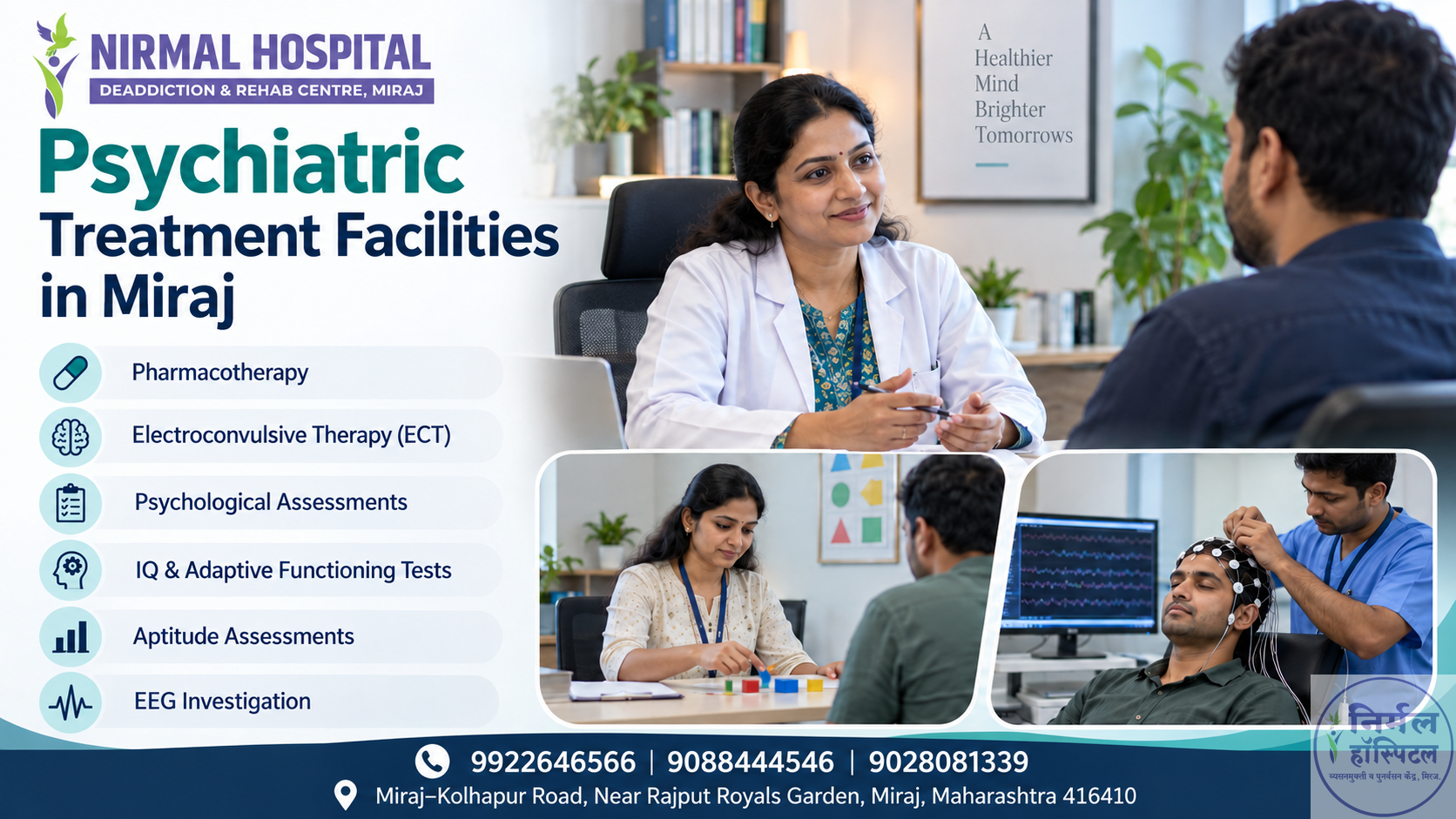
Psychiatric Treatment Facilities in Miraj
At Nirmal Hospital, Miraj, we provide psychiatric treatment and assessment services to help understand mental health concerns and plan individualised care. Our facilities include pharmacotherapy, electroconvulsive therapy (ECT), psychological assessments, intelligence testing, aptitude assessments and electroencephalography (EEG).
Treatment and investigations are recommended according to the person’s symptoms, age, medical history and clinical needs. Not every patient requires every test or treatment.
1. Pharmacotherapy — Medication for Mental Health Conditions
Pharmacotherapy involves using prescribed medicines to manage symptoms of mental health conditions. Depending on the diagnosis, medication may form part of treatment for depression, anxiety disorders, obsessive-compulsive disorder, bipolar disorder, schizophrenia and substance use disorders.
Medication management includes:
- Assessing symptoms, physical health and current medicines.
- Explaining expected benefits and possible side effects.
- Selecting medication and dosage according to individual needs.
- Monitoring response and arranging investigations when required.
- Reviewing treatment through follow-up appointments.
Medicines may be combined with psychological therapies and rehabilitation support. Do not start, stop or change psychiatric medicines without consulting your treating doctor.
2. Electroconvulsive Therapy (ECT)
Electroconvulsive therapy is a medical treatment used for selected severe psychiatric conditions, including severe depression, catatonia and some episodes of mania. It may be considered when other treatments have not helped sufficiently or when a rapid response is clinically necessary.
ECT involves a brief electrical stimulus to the brain to produce a controlled seizure. Modern ECT is performed under general anaesthesia with a muscle relaxant and medical monitoring.
Care involves:
- Psychiatric, physical health and anaesthesia assessments.
- Discussion of expected benefits, alternatives and risks.
- An appropriate informed-consent process.
- Monitoring during treatment and recovery.
- Regular review of symptoms and memory.
Possible side effects include headache, nausea, temporary confusion and memory difficulties. Some people experience longer-lasting memory gaps. The number of sessions depends on clinical need and response.
3. Psychometric Assessment and Psychological Tests
Psychological assessments help clinicians understand emotional difficulties, personality patterns, memory and cognitive functioning. Tests are selected and interpreted by appropriately qualified professionals alongside interviews, observations and clinical history.
Rorschach Assessment
The Rorschach is an inkblot-based psychological assessment that may be used as part of a broader evaluation to explore aspects of perception, thinking and emotional functioning. Its findings should not be used alone to establish a diagnosis.
Memory Assessment
Memory scales assess different aspects of memory, such as learning new information and recalling information after a delay. The psychologist selects an appropriate tool based on the person’s age, language and presenting concerns.
Minnesota Multiphasic Personality Inventory (MMPI)
The MMPI is a standardised assessment used to explore patterns of psychological symptoms and personality functioning. The appropriate version is selected according to the person’s age and assessment needs. Results contribute to a broader clinical evaluation.
Eysenck Personality Questionnaire–Revised (EPQ-R)
The EPQ-R explores broad personality dimensions. It may help inform psychological understanding when interpreted alongside other assessment findings; it does not independently diagnose a psychiatric condition.
Mini-Mental State Examination (MMSE)
The MMSE is a brief cognitive screening tool that assesses areas such as orientation, attention, memory and language.
It can help identify concerns requiring further evaluation, but an MMSE score alone does not diagnose dementia. Interpretation should consider education, language and other factors affecting performance.
4. Intelligence, Developmental and Adaptive Functioning Assessments
These assessments help identify cognitive abilities, developmental needs and everyday functioning. Findings may guide educational planning, support strategies and further clinical assessment.
Intelligence Quotient (IQ) Assessment
IQ testing examines aspects of intellectual functioning using standardised tools. Test selection depends on age, language, communication skills and the purpose of assessment.
Tools may include:
- Binet–Kamat Test of Intelligence: Used to assess intellectual functioning when appropriate for the individual.
- Bhatia’s Battery of Performance Tests of Intelligence: Uses performance-based tasks to assess aspects of intellectual ability in suitable individuals.
Results are interpreted alongside developmental history and everyday functioning. An IQ score alone does not provide a complete picture of a person’s abilities or establish all developmental diagnoses.
Social Quotient (SQ) and Adaptive Functioning
Adaptive functioning assessments explore everyday skills such as communication, self-care, social participation and independence. Some tools provide a Social Quotient.
This assessment complements intelligence testing by helping identify practical support needs.
5. Aptitude Assessment
Aptitude assessments explore strengths and abilities relevant to learning, education and career planning.
Depending on the selected assessment, areas may include:
- Verbal and numerical reasoning.
- Abstract and logical reasoning.
- Spatial abilities.
- Other abilities relevant to educational or vocational choices.
Results are discussed alongside the person’s interests, academic background and goals. Aptitude testing can support informed decisions but does not guarantee success in a particular course or career.
6. Electroencephalogram (EEG)
An electroencephalogram is a test that records the brain’s electrical activity using small electrodes placed on the scalp. EEG is a diagnostic investigation, not a treatment.
A doctor may recommend an EEG when evaluating suspected seizures or certain episodes of altered awareness. During a routine EEG, the electrodes record electrical signals; they do not deliver electricity to the brain.
Preparation instructions depend on the type of EEG requested. Results are interpreted alongside symptoms, medical history and other findings. A normal EEG does not rule out epilepsy, and EEG is not routinely needed for every psychiatric condition.
What to Expect During Your Visit
- Initial consultation: Discuss symptoms, concerns, medical history and previous treatment.
- Individual assessment plan: The clinician recommends relevant tests or investigations when needed.
- Explanation of findings: Results are discussed in relation to your concerns and daily functioning.
- Treatment and follow-up: A care plan is developed and reviewed according to progress.
Please bring previous prescriptions, investigation reports and assessment records. For children, relevant school reports may also be helpful.
Frequently Asked Questions
Does every patient need psychological testing?
No. Psychological testing is recommended when it can help answer a specific clinical question or guide care.
Are IQ testing and aptitude testing the same?
No. IQ tests assess intellectual functioning, while aptitude tests explore abilities relevant to particular learning or vocational areas.
Can psychological tests diagnose a condition on their own?
Diagnosis usually requires a broader clinical assessment. Test findings are considered alongside symptoms, history, observations and daily functioning.
Does every psychiatric patient need ECT?
No. ECT is recommended only for selected clinical situations after individual assessment and discussion of benefits, risks and alternatives.
How long does an assessment take?
The duration depends on the tests required and the person’s needs. Some assessments require more than one appointment.
Book a Consultation at Nirmal Hospital, Miraj
For information about psychiatric treatment facilities in Miraj, contact Nirmal Hospital. Our team can guide you regarding consultations, assessment appointments and preparation requirements.
Nirmal Hospital, Miraj
Miraj–Kolhapur Road, Near Rajput Royals Garden, Miraj, Maharashtra.
Phone: 9922646566 | 9088444546 | 9028081339
Treatment and assessment recommendations are individualised. Outcomes vary according to the condition and the person’s clinical circumstances.


Leave a Reply