

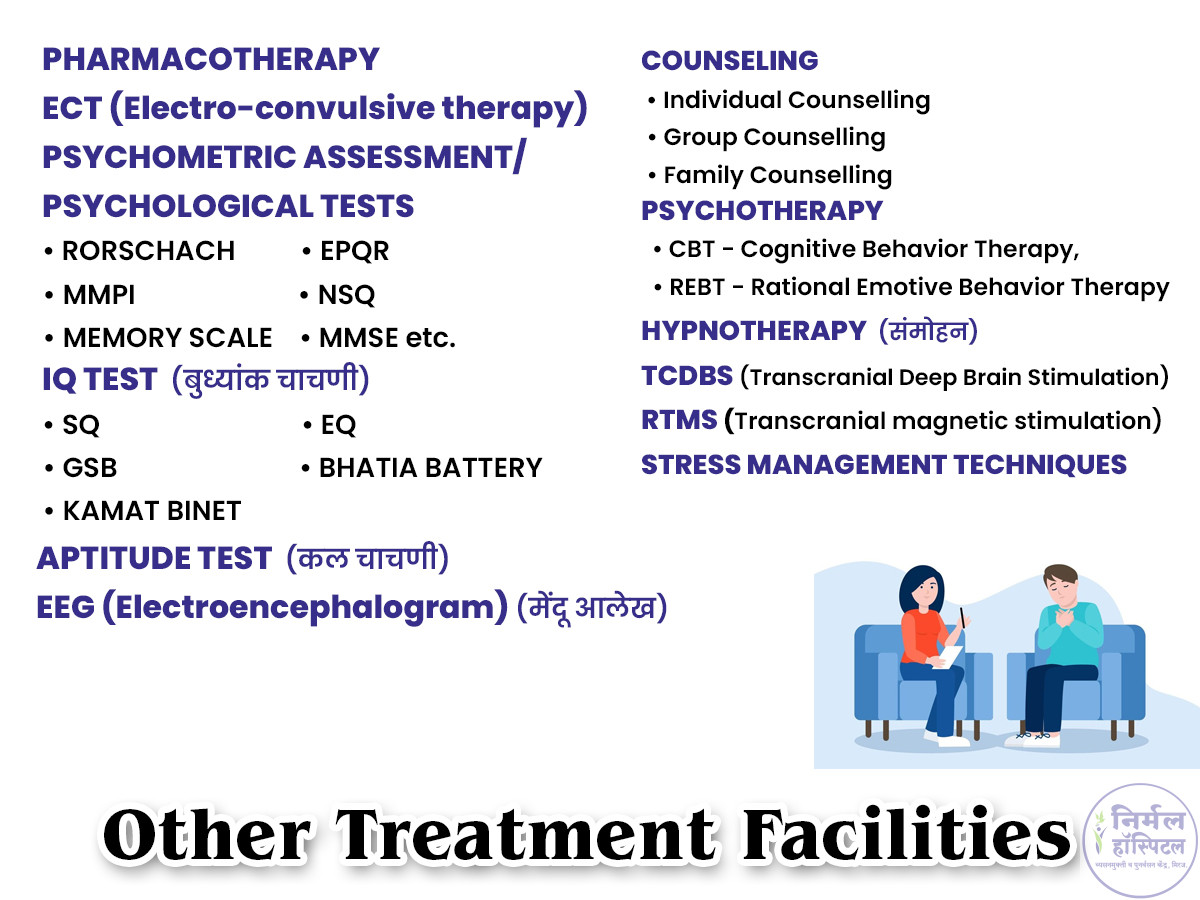
Other Treatment Facilities in Nirmal Hospital Miraj
1. Psychometric Assessment and Psychological Tests
Psychological assessment helps clinicians understand aspects of emotional functioning, personality, thinking and memory. Tests are selected to answer specific clinical questions and interpreted alongside interviews, observations and relevant history.
Assessment tools may include:
- Rorschach assessment.
- Minnesota Multiphasic Personality Inventory — MMPI.
- Eysenck Personality Questionnaire–Revised — EPQ-R.
- NSQ.
- Memory scales.
- Mini-Mental State Examination — MMSE.
These tools serve different purposes. A screening score or an individual test does not independently establish every diagnosis.
2. Intelligence and Related Assessments
Intelligence testing examines cognitive abilities such as reasoning, understanding and problem-solving. Assessment may help clarify a person’s strengths, difficulties and support needs.
Tests listed among our assessment facilities include:
- Binet–Kamat Test of Intelligence.
- Bhatia Battery.
- GSB.
Related assessments may explore social functioning or emotional abilities, depending on the clinical question. These are distinct from intelligence testing.
The psychologist selects suitable tools based on age, language, educational background and assessment needs, and explains their findings and limitations.
3. Aptitude Assessment
Aptitude assessment explores abilities relevant to learning, education and vocational planning.
Results may help guide discussions about strengths, areas requiring support and possible educational or career pathways. They should be considered alongside the person’s interests, achievements, opportunities and preferences.
An aptitude test does not guarantee success in a particular course or career.
4. EEG — Electroencephalogram
An EEG records the brain’s electrical activity using electrodes placed on the scalp. It may be recommended when symptoms suggest seizures or certain other neurological conditions.
EEG is an investigation rather than a treatment. It is not routinely required for every mental health concern, and results must be interpreted in the context of the person’s symptoms and medical history. nhs.uk
5. Counselling Services
Counselling provides a supportive setting to discuss difficulties, understand emotional responses and develop coping strategies.
Individual Counselling
Individual counselling involves one-to-one sessions focused on the person’s concerns and agreed goals.
Sessions may address:
- Emotional distress and stress.
- Relationship difficulties.
- Grief and adjustment to life changes.
- Self-esteem and communication.
- Coping with illness.
- Motivation and challenges during addiction recovery.
Family Counselling
Family counselling helps patients and family members understand difficulties and plan supportive responses.
Sessions may focus on communication, healthy boundaries, caregiver stress, treatment understanding and practical support at home. Family involvement is arranged with appropriate consent and respect for privacy.
Group Counselling
Group counselling involves structured sessions led by a mental health professional for people with related concerns.
Participants may discuss shared challenges, practise communication skills and develop coping strategies. Suitability is assessed individually, and participants are asked to respect one another’s privacy.
6. Psychotherapy
Psychotherapy uses psychological approaches to address patterns of thinking, emotions and behaviour. Treatment goals and methods are discussed with the patient.
Cognitive Behavioural Therapy — CBT
CBT explores how thoughts, feelings and behaviours influence one another. It helps people identify unhelpful patterns and practise more constructive responses.
Depending on the concern, sessions may include:
- Examining unhelpful interpretations.
- Gradually reducing avoidance.
- Developing problem-solving skills.
- Planning manageable activities.
- Practising coping strategies between sessions.
CBT may form part of treatment for depression, anxiety disorders, OCD and other conditions following assessment. www.nhs.uk
Rational Emotive Behaviour Therapy — REBT
REBT examines rigid beliefs and expectations that can contribute to emotional distress.
For example, the belief “I must always succeed” may contribute to excessive pressure and self-criticism. Therapy helps the person explore more flexible expectations, greater self-acceptance and constructive ways to respond to setbacks.
7. Hypnotherapy
Hypnotherapy uses focused attention and therapeutic suggestion to work towards agreed goals. It may be considered for selected concerns following assessment by an appropriately trained professional.
The person remains able to reject suggestions and stop the session. Evidence and suitability vary by condition. Hypnotherapy should not replace necessary medical or psychological treatment. www.rcpsych.ac.uk
8. rTMS — Repetitive Transcranial Magnetic Stimulation
rTMS is a non-invasive treatment that uses magnetic pulses delivered through a coil positioned against the scalp.
A psychiatrist may consider it for selected patients, particularly those with depression who have not responded adequately to other treatments. Patients generally remain awake during sessions.
Suitability requires assessment, including a review of seizure history and implanted devices. Possible side effects include headache and scalp discomfort; seizures are rare.
The treatment schedule, expected benefits and limitations are discussed individually. Response varies, and follow-up remains important. www.nimh.nih.gov
9. Stress Management Techniques
Stress can affect sleep, concentration, emotional wellbeing and relationships. Stress management focuses on recognising sources of pressure and developing practical ways to respond.
At Nirmal Hospital, guidance may combine lifestyle strategies, relaxation, counselling and psychological therapy.
Balanced Diet and Healthy Routines
Regular meals, adequate hydration and a balanced diet support general wellbeing. Avoid using alcohol or tobacco to cope with stress, and consider reducing excessive caffeine when it affects sleep or increases restlessness.
Yoga and Relaxation
Gentle yoga, comfortable breathing exercises, mindfulness and progressive muscle relaxation may help manage tension.
Practices should suit the person’s physical health and comfort. Guidance may be needed when medical conditions or mobility limitations are present.
Regular Exercise
Walking, cycling, dancing and other enjoyable activities can support wellbeing and stress management. Begin with manageable activity and build a routine suited to your health and abilities. www.mayoclinic.org
Hobbies and Recreation
Reading, singing, listening to music, gardening and creative activities can provide enjoyable breaks from everyday demands. Short outings, travel or time outdoors may also be included according to preferences and practical circumstances.
Healthy Relationships and Intimacy
Stress management discussions may include communication, emotional closeness and relationship concerns.
For adults, physical affection and sexual intimacy should reflect mutual consent, comfort and preferences. Sexual activity is not a prescribed treatment for stress and should never become an obligation.
Professional Support and Psychological Therapy
Persistent stress that affects daily life may benefit from professional assessment. Counselling, CBT or REBT may be considered to explore stress triggers, unhelpful expectations and practical coping strategies.
Healthy Emotional Expression — Catharsis
Catharsis is a term sometimes used to describe emotional expression and a sense of relief.
In counselling, the focus is on discussing feelings safely, understanding them and developing coping skills. Journaling or creative expression may also help people explore emotions. Emotional expression alone should not be presented as a cure or encouragement to act out anger.
Sleep, Planning and Boundaries
Consistent sleep routines, realistic priorities, regular breaks and healthy boundaries can form part of a stress management plan. These strategies are adapted to the person’s daily responsibilities and circumstances.
What to Expect at Your First Appointment
Your first consultation focuses on understanding your concerns and identifying suitable care.
The assessment may cover:
- Current symptoms and their duration.
- Effects on work, relationships and daily activities.
- Medical and mental health history.
- Current medicines and previous treatments.
- Personal preferences and treatment goals.
Your clinician will explain recommended options and agree on the next steps with you.
Frequently Asked Questions
Do all patients need medication?
No. Recommendations depend on the diagnosis, symptom severity and individual needs. Some people may receive psychological support, while others may benefit from medication or a combination of approaches.
How many counselling or psychotherapy sessions are needed?
The number varies according to the concerns, therapy used and progress. Your therapist will discuss an initial plan and review it with you.
Are psychological tests necessary for everyone?
No. Tests are recommended when they can help answer a specific assessment question or guide care.
Are counselling sessions confidential?
Sessions are handled with respect for privacy. Your clinician will explain confidentiality and its limits, including relevant safety and legal obligations.
Can family members participate in treatment?
Yes, when appropriate and with consent. Family involvement may help with communication, understanding treatment and planning support at home.
Can stress management replace psychiatric treatment?
Lifestyle changes and relaxation may support wellbeing, but they do not replace necessary treatment for a diagnosed condition.
Book an Appointment at Nirmal Hospital, Miraj
For information about mental health treatment facilities in Miraj, contact Nirmal Hospital to arrange an assessment and discuss suitable care.
Nirmal Hospital, Miraj
Psychiatric, De-Addiction & Rehabilitation Centre
Address: Miraj–Kolhapur Road, Near Rajput Royals Garden, Miraj, Maharashtra – 416410
Contact: 9922646566 | 9088444546 | 9028081339
This information is for general awareness and does not replace an individual clinical assessment. Treatment suitability and outcomes vary.


Leave a Reply